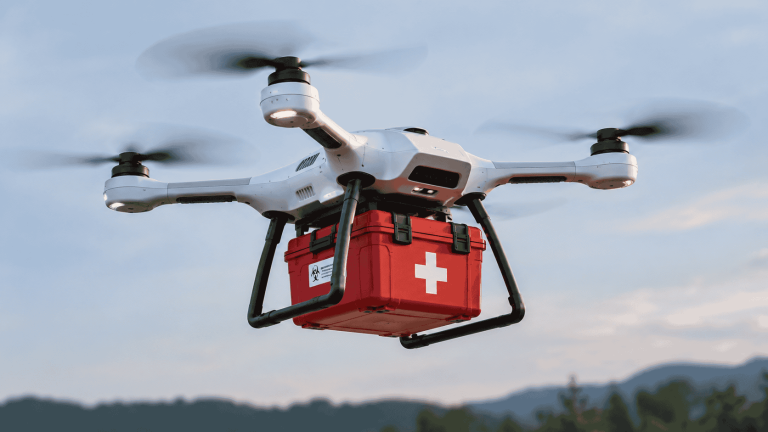
A blood tube that reaches the laboratory in 25 minutes, travelling over fields and past traffic jams: what sounded like science fiction just a few years ago is now everyday reality at the first hospital sites in Germany. Drones are no longer just transporting laboratory samples on a trial basis, but are now flying fixed routes.
For us, as a provider of route planning software, this is an exciting field. The time between sample collection and analysis plays a key role in determining the quality of a diagnostic result. And it is precisely this time that our customers plan for every day. In this article, we outline the current state of drone transport, what matters when it comes to samples, and the areas in which we are conducting our own research.
Why drones at all?
Traditional courier services are reaching their limits: congested roads, long journeys in rural areas and a shortage of drivers. Hospitals are also under pressure in terms of costs and staffing, and are consolidating their laboratories at central locations. This means that the distances samples have to travel are getting longer, but the time slots are not.
This is precisely where drones really come into their own:
- Speed: You’re travelling as the crow flies and won’t encounter any traffic jams. With Helios, the 32-kilometre journey from Breisach to Müllheim takes around 25 minutes.
- Predictability: Transport can be arranged as and when required, rather than only at fixed collection times.
- Sustainability: Electric drones replace individual car journeys and ease the burden on road traffic.
- Widespread access to care: Smaller hospitals in particular, which do not have their own laboratories, benefit from faster test results.
From a pilot project to everyday practice.
For years, it was limited to subsidised trials. Now, the first routes are operating regularly:
- Zollernalb Hospital (Albstadt – Balingen): The German Federal Aviation Authority has, for the first time, authorised autonomous flights over a populated area here. The flight is controlled by a pilot in Berlin.
- Asklepios Clinics (Selent – Bad Oldesloe): Samples are sent off daily. The car only runs in strong winds now.
- Helios Clinics (Breisach – Müllheim): 32-kilometre route, up to 3 kg payload, around 75 km/h.
- Ingolstadt Hospital: Regular flights between hospitals are planned from mid-2026.
Nevertheless, the overall picture remains sobering. According to the DLR Test Centre, the use of drones in the healthcare sector is, on the whole, not yet in regular operation. However, the first economically viable models are emerging in the field of sample transport.
What the sample needs whilst in transit.
In the end, only one thing matters: the sample must arrive at the laboratory exactly as it was collected. The same pre-analytical rules therefore apply during the flight as they do on the ground, albeit under different conditions.
- Packaging: Diagnostic samples are classified as ‘Biological substance, Category B’ (UN 3373). They are transported in the prescribed triple packaging in accordance with P650 – in the drone, usually in an additional, secured transport box.
- Temperature: Many parameters can only be stored at room temperature. Insulated boxes and temperature loggers ensure that the cold chain is maintained even when transported by air.
- Shock: Vibration and hard landings can, for example, contribute to haemolysis. Studies to date have found no significant differences compared with road transport, provided the goods are properly packaged.
- Traceability: Take-off, landing and handover are recorded digitally. This ensures that every sample can be traced without any gaps.
What the problem still is.
Technology is more advanced than the framework conditions. Three factors are holding back its widespread adoption:
- Authorisation: Flights beyond visual line of sight and over residential areas require an operating licence from the Federal Aviation Authority, subject to a comprehensive risk assessment. Project managers speak openly of an enormous bureaucratic burden.
- Weather: Even a light breeze or a little rain can be enough to prevent the flight. A fallback glider on the ground is therefore compulsory.
- Networking: At an altitude of 50 to 80 metres, drones frequently switch between mobile phone cells. This can make the connection unstable – a critical issue for reliable operation.
We are conducting research in collaboration with: SIDDA and AI4Drone.
This is precisely where two research projects from North Rhine-Westphalia, in which we are involved, come in. Both will run until 2027; the consortium is led by Karl Koerschulte GmbH in Lüdenscheid, with scientific support provided by, amongst others, the South Westphalia University of Applied Sciences.
SIDDA – Sustainable Intermodal Drone Delivery Airline. The project is developing an automated drone network for time-critical deliveries. It connects fixed and mobile micro-hubs – small transhipment points – with automated drone airlines. The aim is to integrate drones seamlessly into existing logistics chains rather than operating them as stand-alone solutions. One key component: weather data is automatically retrieved and incorporated into flight planning.
AI4Drone. The focus here is on artificial intelligence. It calculates optimal routes and networks, taking into account traffic, weather and delivery priorities in real time. When it comes to laboratory samples, prioritisation is particularly interesting: an emergency sample should be flown faster than a routine sample.
Outlook.
Drones won’t replace transport services overnight. However, they will complement them in situations where time is short and the journey is long. It is crucial that the technology, airspace and laboratory processes are all compatible, and that is precisely what we are working on.
Would you like to find out more about the projects, or are you wondering how drones might fit into your route planning in future? Please feel free to get in touch.