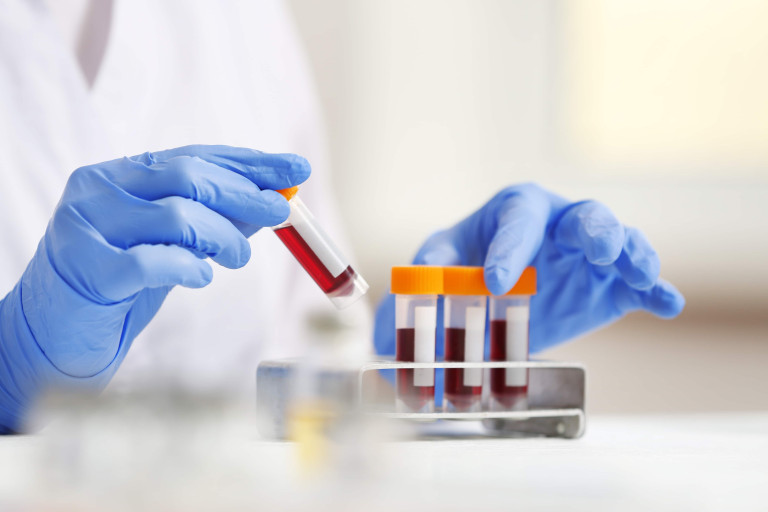
Temperature fluctuations during the transport of laboratory samples can compromise the reliability of laboratory results. Live temperature tracking allows critical developments to be identified whilst the samples are in transit. This enables a prompt response whilst also simplifying documentation.
The problem is that temperature fluctuations are detected too late.
Whether blood samples, tissue samples or microbiological material: there are hardly any fixed temperature requirements for sample transport. Rili-BÄK and DIN EN ISO 15189 merely require laboratories to determine the transport conditions themselves and to verify compliance. How this is done remains open to interpretation, and so many laboratories limit themselves to the bare minimum: measuring and documenting. Formally, that is sufficient. However, a measurement that is only evaluated after the journey has been completed does nothing to alter the condition of the sample.
In traditional temperature logging, data loggers operate independently of the route planning and are only read out once the journey has been completed. Whilst any deviation is then documented, no one was able to take action during transport. Which journey, which consignors and which samples were affected must subsequently be painstakingly determined by hand in the laboratory.
Live temperature tracking goes one step further: it highlights temperature deviations whilst the tour is still in progress.
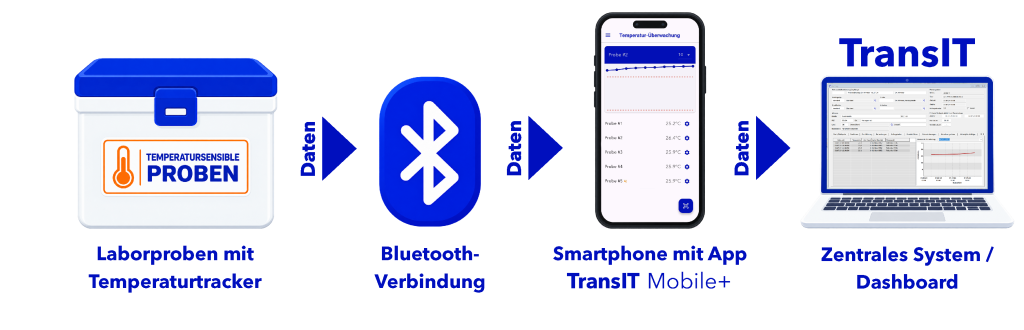
This is how temperature tracking works with TransIT.
With TransIT, temperature monitoring is integrated directly into existing sample logistics processes.
Certified temperature sensors continuously measure the temperature inside the transport containers. They automatically transmit their readings via Bluetooth to the TransIT Mobile+ driver app, which forwards the data in real time to the TransIT route planning system.
As the data is transmitted via the existing driver app, neither an additional app nor a separate transmission infrastructure is required.
Be informed in good time, respond effectively.
If defined temperature limits are exceeded, the information is made available directly to the relevant parties:
- Driver: Receives a push notification via TransIT Mobile+ and can respond, for example by using a spare ice pack.
- Transport service: Identifies affected routes and bookings directly in TransIT and can take appropriate action.
- Laboratory: Can see on the arrival monitor, even before the samples arrive, whether any temperature deviations have occurred during transport.
This enables critical developments to be identified at an early stage and potential measures to be coordinated.
Automatically assign temperature data to the correct consignment.
A key advantage of the integrated solution is the automatic linking of temperature and transport data.
Each measurement is linked to the relevant transport order, transport container and measuring device, throughout the entire journey and even when drivers change. This enables a complete record of which samples were affected by temperature deviations and for how long.
There is no need for subsequent manual reconciliation of different data sources. Every transport is automatically documented. It would be impossible to do this manually; in such cases, it usually comes down to spot checks.
Documentation and analysis at the touch of a button.
The data recorded remains available for quality management purposes even after transport.
TransIT enables the analysis of temperature trends, instances where limit values are exceeded, and the duration and extent of any deviation. Loading and unloading times can also be taken into account.
This makes it possible to identify the relevant consignments specifically and to document the temperature conditions in a traceable manner.
Conclusion: Going the extra mile.
Temperature tracking involves more than simply recording measurements. Measurement and documentation are mandatory. It is crucial for quality that deviations are detected in good time, linked to the relevant shipments and analysed in a way that allows for full traceability.
With the integration of temperature sensors, TransIT Mobile+ and TransIT, temperature monitoring thus becomes an integral part of day-to-day sample logistics.
The result: greater transparency, less manual work and better options for taking action in the event of critical temperature trends.
Find out more about live temperature tracking with TransIT.
Would you like to know how temperature monitoring can be integrated into your existing transport processes?
Contact us to find out more about TransIT temperature tracking.