


Intelligent route planning:
Save costs and CO2 with the right software.
Why do I need route planning software for my logistics ?
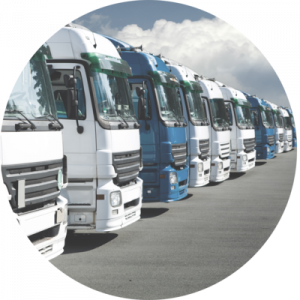
Video: Route planning in 100 seconds.
Plan your logistics tours cost-efficiently with the right software now.
Would you like to improve the efficiency of your dispatching and planning, increase the profitability of the fleet and reduce with your fleet CO2-emissions?
Move away from Excel, paper and Google Maps now! Switch to route planning that digitises processes including an app, web solutions, a planning cockpit and reporting.
Using route planning software saves you time and money.
What is the potential of route optimisation?
With our route planning savings calculator, you can discover in just a few steps how much potential for savings lies within your daily dispatching and logistics operations. Efficient route planning is a key factor in reducing costs, improving route utilisation and making the best use of available resources. Based on your input, our calculator provides an initial estimate of how much your business could benefit from optimised route planning with TransIT – free of charge, with no obligation, and available immediately.
Overview: Advantages of intelligent route planning.
- Faster, better planning and optimisation
- Algorithms that automatically take into account the requirements of your business
- Automated use of relevant master data
- Uniform utilisation of the routes
- More efficient communication through apps and telematics
- Target vs. actual comparison in real time
- Simulate using alternative plans
- Better business management through in app tools
How does TransIT optimise your route planning?
TransIT implements route planning significantly faster than manual solutions. The handling of large amounts of data is simplified. For example, you can optimise 3,000 routes in the shortest possible time. You can use the time saved to go through planning alternatives and continuously improve the operational business.
These advantages make TransIT the ideal software for route planning and route optimisation.
TransIT is simple.
The software automatically creates route plans and can also take into account even the most complex requirements (e.g. heterogeneous vehicle fleets, multiple capacity dimensions, opening hours etc.).
TransIT is efficient and sustainable.
Because our applications are modular they can be adapted to your requirements at any time.
TransIT is future-proof.
Benefit from the continuous development of the software and our cooperation with leading universities (e.g. RWTH Aachen, University of Mainz) and research institutions such as Fraunhofer.
Route optimisation with software:
How your company benefits.
The entire workflow with TransIT is digitised: Create optimised routing plans in the planning cockpit. Release them and transfer them to your employees' app. Monitor the status of all orders and employee vehicles in real time. Detect delays and proactively notify your customers. Carry out automated target vs. actual comparisons to continuously improve your planning. Use extensive reporting options to increase quality and profitability.
These companies already benefit from
route optimisation through TransIT:






Route optimisation for many industries.
Our customers include companies from very different industries. Examples include: postal and parcel services, service companies, wholesale companies, wholesale bakeries, waste disposal companies, medical laboratories and passenger transport companies. The algorithms of the TransIT software offer endless possibilities to meet the different requirements of the industries in terms of planning.
How does route planning work?
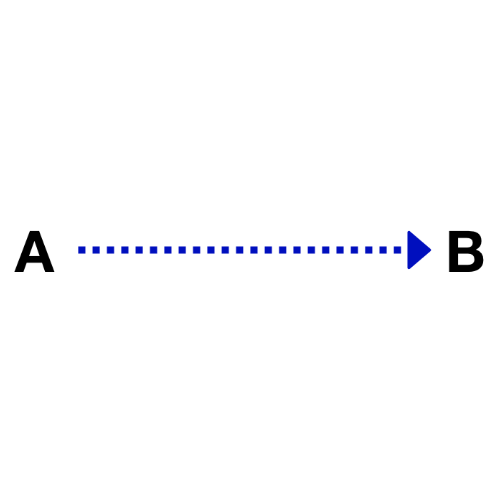
The starting point is the transport or delivery order: a person is to be transported from A to B, goods are to be collected and delivered.
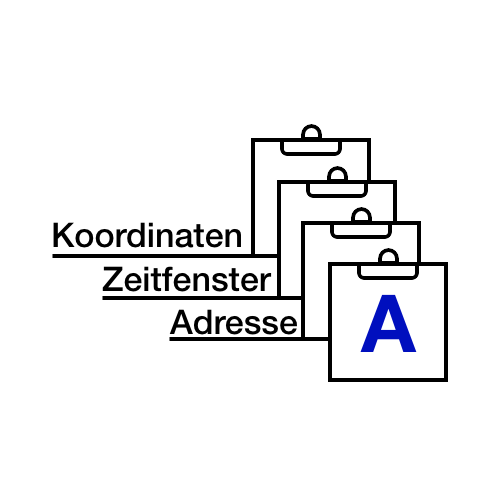
To do this, you create new orders in the tour planning software. These have at least one address and one delivery window. With the help of automated geocoding, the system assigns longitude and latitude to the addresses, similar to navigation software.
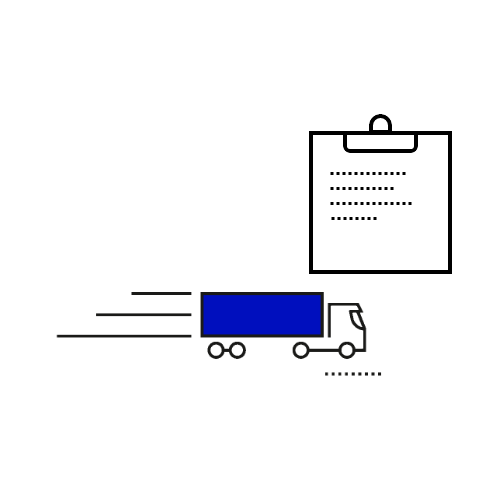
In order to optimise tours, a vehicle fleet is also created. This contains vehicles that are available at certain times with certain characteristics. The route optimisation software determines whether an order can be carried out with a vehicle by assigning qualifications or other properties such as vehicle capacity.

This is followed by the actual route optimisation: The TransIT software uses highly efficient algorithms specially developed by gts to distribute the orders to the vehicles and carry out sequence optimisation. Driving times and distances between orders are calculated concretely.
Simple practical example:
This is what the optimised route plan looks like.
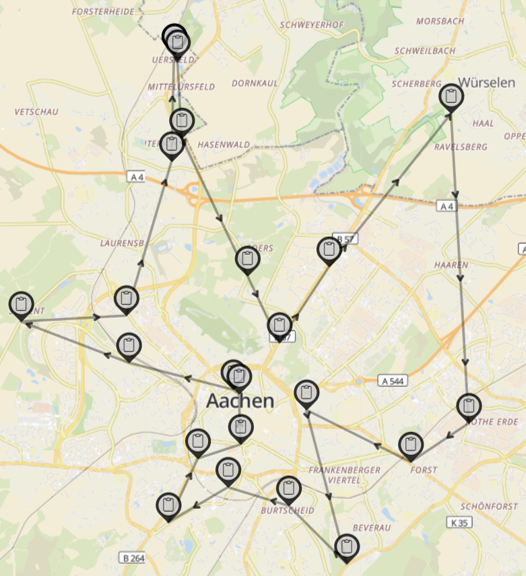
Original route: 59 km
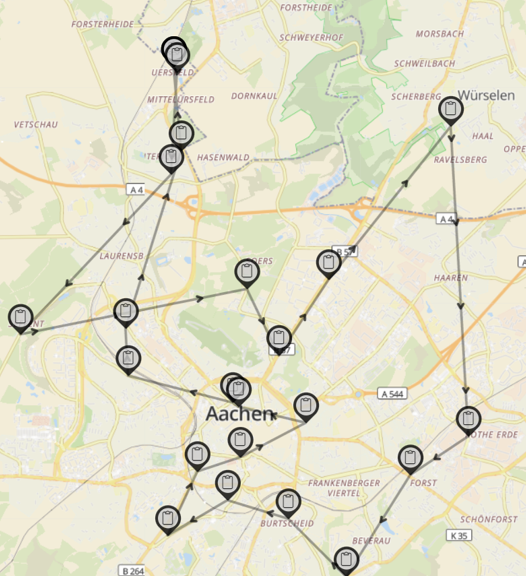
Optimised route: 53 km
Using the TransIT software for route planning, you save 11 % distance, CO2 and time in this case.
Find out your potential
using the savings calculator.
Would you like to know how much you could save on your route planning? Then try our free, no-obligation savings calculator and get an initial estimate in just a few steps.
Here’s how it works: Based on the information you provide, the savings calculator estimates the potential for cost reduction and efficiency gains in your route planning. You will then receive an initial overview of how you can benefit from optimised route planning. The results are based on estimated figures. If you would like a detailed and reliable analysis based on your actual logistics data, we would be happy to look at your specific case in person.
Frequently asked questions (FAQs).
Route planning refers to the process of logically combining orders, customer locations or delivery points into optimal routes. The aim is to minimise distances, costs and time while maximising service quality.
Digital route planning saves time in dispatching, lowers operating costs and reduces CO₂ emissions. Automated systems calculate optimal routes, take into account restrictions such as time windows, vehicle types or traffic volume – and respond flexibly to changes.
Tour planning is used in, among other things:
Logistics & Transport
food delivery
Recycling
Technical field service
Pharmacy and laboratory services
Crafts and service businesses
Manual planning is done using Excel, maps or gut feeling – but it is prone to errors and time-consuming. Automatic route planning uses algorithms and artificial intelligence to calculate the best solution from millions of possibilities in seconds.
Yes. Even with just 3–5 vehicles, automated route planning brings noticeable benefits – e.g. time savings, better utilisation, fewer empty runs and greater customer satisfaction.
A basic distinction is made between strategic, tactical and operational route planning:
- Strategic route planning:
- long-term (months/years)
- Objective: Define the basic structure of logistics – e.g. location selection, area divisions, depot planning, fleet composition
- usually based on simulation or optimisation models
- important for expansion, tenders or network adjustments
- Operational route planning
Daily/short-term planning of tours based on specific orders
Objective: efficient and reliable processing, consideration of time slots, traffic conditions, order priorities, etc.
usually done automatically using software like TransIT
- Tactical vehicle routing
medium term (e.g. weekly planning, rollouts)
e.g. for recurring orders, weekly routes or seasonal adjustments
Modern systems such as TransIT support all levels of route planning – from strategic setup to daily route optimisation.