Whether it’s a delivery service, a waste collection company or a transport service: anyone who uses vehicles on a daily basis has to decide which vehicle should carry out which jobs and in what order. That is precisely what route planning is all about. This guide explains what route planning is, introduces the three types of route planning, outlines the process in five steps and explains when it’s worth investing in software for this purpose.
Route planning refers to the allocation of jobs to vehicles and the determination of the order in which the jobs are to be carried out. The aim is to minimise distances, costs and time whilst adhering to time slots, vehicle capacities and other requirements.
What is route planning?
In logistics, route planning refers to the process of determining which vehicles will be used to complete a series of orders and the order in which the vehicles will travel to their destinations. The starting point is always a transport or delivery order: goods are to be delivered or collected, a person is to travel from A to B, or a service technician is to visit a customer. Every order has a location and, in most cases, a time slot within which it must be completed.
Route planning answers three questions: Which vehicles are used? Which orders are assigned to which vehicle? And in what order are the orders visited? The result is a route plan. For each vehicle, it contains a route that usually starts at the depot, visits the assigned stops in a fixed order, and ends back at the depot. In academic circles, this task is known as the vehicle routing problem (VRP).
What sounds simple is mathematically challenging. Even for a single vehicle making 20 stops, there are around 2.4 trillion possible sequences. With multiple vehicles and constraints such as time slots, loading capacities, or driving and rest periods, the task becomes significantly more complex. Good route planning therefore does not simply seek the shortest route, but the most cost-effective solution that meets all practical requirements.
Objectives of route planning.
Good tour planning serves several purposes at once:
- Cutting costs: Fewer kilometres, fewer vehicles and fewer working hours reduce expenditure on fuel, staff, tolls and the vehicle fleet.
- Strecke und CO₂ reduzieren: Kürzere und besser abgestimmte Touren senken den Kraftstoffverbrauch und damit die Emissionen, ein wachsender Faktor für Nachhaltigkeitsberichte und Ausschreibungen.
- Ensuring vehicles are utilised evenly: Loading capacities and operating times are allocated in such a way that no vehicle travels half-empty whilst another is operating at full capacity.
- Meeting time slots and customer requirements: Punctual deliveries and reliable arrival times ensure customer satisfaction and avoid costly repeat journeys.
- Easing the burden on drivers: Realistic, manageable routes with scheduled breaks help to avoid overtime and stress, and make the job more attractive, particularly at a time when there is a shortage of drivers.
These objectives are often at odds with one another: the shortest route does not always fit in with customers’ time slots, and minimising the number of vehicles can be at the expense of the drivers. The aim of route planning is to find the best balance for the company in question.
Tour planning, route planning, tour optimisation: what is the difference?
| Term | Meaning | Example |
|---|---|---|
| Tour planning | The best route from A to B or via fixed stops | Navigation system |
| Route Planning | Allocate orders to vehicles and determine the order | Which lorry delivers to which branches? |
| Route optimisation | Route planning using algorithms that calculate the most cost-effective solution based on all the given parameters | Software calculates the best plan from millions of possibilities |
| Scheduling | Ongoing management of routes on the day of operation, including rescheduling | An urgent job comes in, and a vehicle breaks down |
Strategic, tactical and operational route planning.
Tour planning takes place at three levels, which differ in terms of time horizon and objective. The earlier the planning begins, the greater its impact on costs.
| Level | Time horizon | Objective | Examples |
|---|---|---|---|
| Strategic | Months to years | Define the basic structure of the logistics system | Site selection, depot planning, catchment area demarcation, fleet composition, tenders |
| Tactically | Weeks to months | Planning recurring processes | Weekly routes, regular group rides, seasonal adjustments, roll-outs |
| Operational | On the day or at short notice | Handling specific orders efficiently | Daily planning with time slots, traffic conditions and priorities; rescheduling in the event of cancellations |
Strategic route planning.
Strategic route planning defines the basic structure of the logistics operations for months or years. This is where decisions are made regarding which sites will be used for deliveries, the size and composition of the fleet, and how the delivery area is to be divided into routes or service areas. Typical triggers include the opening of a new depot, participation in a tender, expansion into new regions, or the question of whether an additional vehicle is worthwhile.
As there are no specific orders at this stage, strategic planning relies on historical or statistical data, such as the average number of stops per week or recurring patterns. On this basis, various scenarios are simulated and compared with one another.
Example: A waste management company divides its urban area into collection districts so that each vehicle has a similar workload on every day of the week. This division then forms the basis for the waste collection calendar for households, which remains in place for years.
Mistakes at this stage have long-lasting consequences: an awkwardly situated depot or poorly laid-out areas result in unnecessary kilometres every day, which even the best daily planning cannot make up for.
Tactical route planning.
Tactical route planning forms the link between strategy and day-to-day operations. It involves planning weeks or months in advance and is geared towards orders that recur on a regular basis. This results in what are known as ‘regular routes’ or ‘fixed routes’: set routes that are driven in the same way, for example, every Monday or every two weeks.
Regular delivery routes ensure reliability. Customers know when they will be supplied, drivers are familiar with their routes and their contacts, and the dispatch team does not have to start from scratch every day. Tactical planning is revised when the circumstances change, for example when new customers are added, due to seasonal fluctuations such as the Christmas rush, or when switching to new software.
Example: A large bakery delivers to several branches and business customers every morning. Instead of planning anew each day, it sets fixed weekly routes that adhere to the branches’ early delivery time slots and ensure an even utilisation of its vehicles. In the summer, when branches in holiday regions require more stock, the routes are adjusted.
It is important to review regular routes on a regular basis. Customer patterns change gradually, and routes that were suitable years ago are often considerably longer than necessary today.
Operational route planning.
Operational route planning is part of day-to-day operations. It involves planning the specific deliveries for the following day or even for the current day. Factors taken into account include the actual delivery volumes, the available vehicles and drivers, customers’ time slots and the current traffic conditions. Where there are regular routes, these serve as a starting point and are adapted to the day’s deliveries.
Hardly a day goes exactly as planned. Urgent orders crop up, customers cancel, a vehicle breaks down or a traffic jam delays the route. Operational planning therefore flows seamlessly into dispatch: routes are rescheduled during the day, drivers are informed and customers are notified of any delays. At the end of the day, a comparison of planned versus actual figures shows where the plan and reality diverged.
Example: Every afternoon, a transport service plans the journeys for the following morning: who needs to go to school, the workshop or the doctor’s, and when; who needs a wheelchair space; and what is the maximum duration of a journey? If a passenger cancels in the morning due to illness, the route is adjusted immediately so that the remaining passengers do not have to spend an unnecessarily long time travelling.
It is at this level that time pressure is greatest: a plan often has to be drawn up in a matter of minutes. This is precisely where Excel and experience-based knowledge reach their limits most quickly.
Modern software supports all three levels, from strategic set-up to day-to-day optimisation.
How does route planning work? The process in 5 steps.

- Entering orders: Each order has at least one address and a time slot, e.g. delivery between 9 am and 12 noon. The addresses are geocoded, i.e. converted into coordinates.
- Define the vehicle fleet: Which vehicles are available, when, and with what capacity and equipment? Which drivers have which qualifications?
- Define the framework conditions: time slots, opening hours, driving and rest periods, driving bans and other requirements (see the next section).
- Creating and optimising routes: Orders are allocated to vehicles and arranged in the most efficient order. Journey times and distances between stops are calculated precisely.
- Implementation and evaluation: Routes are sent to the drivers; adjustments are made whilst they are driving; afterwards, a comparison of planned versus actual results shows where the planning could be improved.
What makes tour planning complex.
With three vehicles and twenty stops, it’s still possible to work it out in your head. But with every additional order, the number of possible combinations grows rapidly, and every extra constraint narrows down the range of viable solutions.
- Time slots and opening hours, including several per day or per weekday
- Vehicle capacities, often in several dimensions at once (weight, volume, crates, passengers)
- Compatibility between the job and the vehicle, e.g. tail-lift, clearance height, special permits
- Driving and rest periods, and rules on breaks
- Delivery and collection in a single journey, e.g. empty bottles or returns
- Multiple charging points and recharging whilst on the move
- Prohibitions on mixed loading for goods that must not be transported together
- Road conditions such as no U-turns, weight restrictions and driving bans
- Industry standards, e.g. maximum journey times for passenger transport or the cold chain for foodstuffs
A route is only good if it is not only short but also rideable – in other words, if it meets all the practical requirements.
Route planning with Excel and Google Maps: What are the limitations?
Many companies plan their routes using Excel, paper, maps and the experience of their dispatchers. This works when there are only a few vehicles, but as the number of orders increases, it becomes time-consuming and prone to errors. Knowledge is tied to individual staff members, rescheduling takes hours, and it is almost impossible to check whether a plan is truly cost-effective.
| Criterion | Manual planning | Planning using software |
|---|---|---|
| Time required | Hours per day | Minutes, even with thousands of trips |
| Quality | Empirical data | Mathematically optimised in accordance with all specifications |
| Rescheduling | Laborious, often improvised | Quick, with immediate visible results |
| Knowledge | In the minds of a few dispatchers | Documented in the system |
| Analysis | Hardly possible | Target versus actual comparison, key performance indicators, carbon footprint |
At what point does route planning software become worthwhile?
Even with as few as three to five vehicles, automated route planning delivers tangible benefits. On average, an optimised route plan saves around 15 per cent in costs compared with manual planning. With around 15 vehicles or more, it is usually possible to save the cost of an entire vehicle.
Checklist: Is it time to invest in route planning software?
- Planning the daily routes takes more than an hour.
- Only one or two staff members can plan the routes.
- Time slots are regularly missed.
- Vehicles are utilised unevenly, and there is overtime.
- Last-minute changes throw the daily schedule into disarray.
- You don’t know exactly how much a tour actually costs.
Practical example:
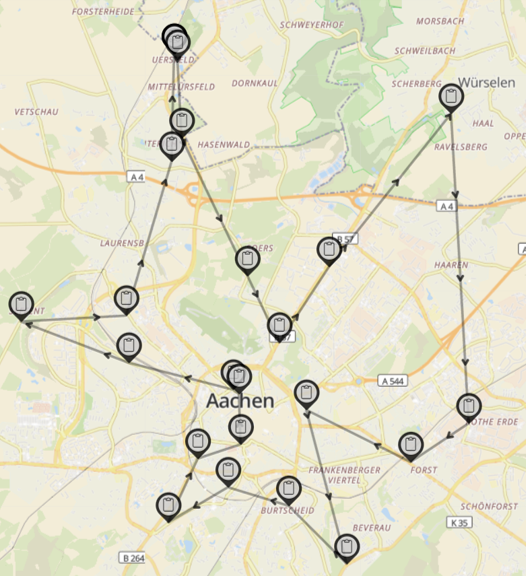
Original route: 59 km
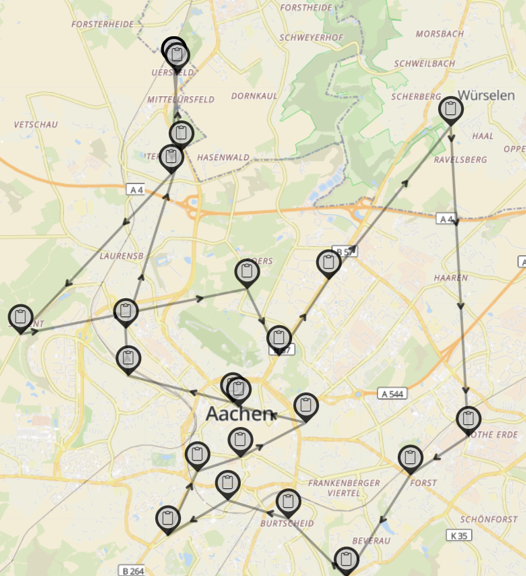
Optimised route: 53 km
How much could your business save? With our free savings calculator, you can get an initial estimate in just a few steps.
Optimise routes automatically instead of planning them in Excel: this is how the route planning software TransIT works.
Route planning across various sectors.
| Industry | A typical challenge | Find out more |
|---|---|---|
| Disposal | Fixed collection areas, waste collection calendar, no-turn zones | Route planning for waste collection companies |
| Passenger transport | Maximum journey time, wheelchair spaces, daily changes | Software for transport services & passenger transport |
| Bakeries | Early delivery time slots, lots of branches | Route planning for bakeries |
| Food | Cold chain, tight time slots | Route planning for food logistics |
| Wholesale | Deliveries and collection of returnable bottles in a single trip | Route planning for the wholesale sector |
| CEP | A great many stops, deliveries and collections | Route planning for CEP services |
| Health and Laboratories | Time-sensitive samples, fixed collection times | Route planning for laboratories and the healthcare sector |
| Field Sales and Service | Technicians’ qualifications, time slots lasting several weeks | Resource planning for field staff and service engineers |
Frequently asked questions about planning a tour.
What is route planning?
Route planning refers to the process of logically grouping orders, customer locations or delivery points into optimal routes. The aim is to minimise distances, costs and time, whilst ensuring the highest possible quality of service.
What is the difference between trip planning and route planning?
Trip planning finds the best route between specified points, just like a sat-nav. Route planning starts one step earlier: it first decides which vehicle will handle which jobs and in what order they will be visited. Route planning is therefore part of tour planning.
What does route optimisation mean?
Route optimisation is the computer-aided form of route planning. Specialised algorithms examine a vast number of possible combinations and calculate the most cost-effective route plan that complies with all requirements, such as time slots, capacities and driving times. This is achieved in a matter of minutes, whereas manual planning takes hours and still rarely yields the best solution.
What information do I need to plan my route?
Three types of data are required: firstly, the orders, including address, time slot and quantity; secondly, the vehicle fleet, including vehicle types, capacities, operating times and locations; and thirdly, the general conditions, such as opening hours, driving and rest periods, or driving restrictions. Much of this data is already available in Excel spreadsheets or in the enterprise resource planning system and can be imported from there.
Which key figures are important in route planning?
Commonly used key performance indicators include the number of kilometres travelled, the cost per stop or per route, vehicle utilisation, the number of stops per route, punctuality within time slots, and CO₂ emissions. A comparison between planned and actual routes – known as a ‘target versus actual’ comparison – is particularly insightful.
What is an open tour?
An open route does not start or end at the vehicle’s location. For example, it may start directly at the first job or end at the last customer’s premises, such as when a driver sets off from home or the vehicle is parked overnight at a different location. Good route planning can take such routes specifically into account.
How does route planning help with climate action?
Optimised routes are shorter, and often fewer vehicles are needed to complete the same jobs. This reduces fuel consumption and, consequently, CO₂ emissions. At the same time, digital route planning provides reliable figures for the carbon footprint and for sustainability reports.

About the author
Dr. Tore Grünert
Dr Tore Grünert is the Managing Director of GTS Systems and Consulting GmbH, the market leader in route planning software. He has been working in the field of route planning and route optimisation for over 25 years, combining scientific methods with the practical experience of waste management companies, transport services and delivery firms.