


Anyone planning vehicle routes today is familiar with the problem: time slots, customer preferences, traffic conditions, vehicle capacities and legal requirements all have to be balanced simultaneously. And this is often done under time pressure. Traditional planning by hand or using Excel spreadsheets quickly reaches its limits. This is precisely where AI route planning comes in: it promises to automate complex planning processes and create noticeably more efficient routes. But what is really behind it, and what are the actual benefits for businesses?
What does AI route planning actually mean?
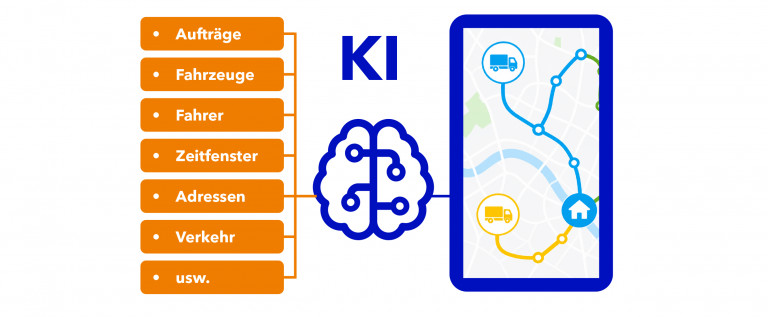
AI route planning refers to the use of intelligent algorithms to automatically calculate and optimise vehicle routes. Rather than manually organising stops based on experience, the software analyses a wide range of parameters simultaneously: distances, time slots, vehicle capacities, driver qualifications, real-time traffic data and historical patterns.
The term ‘artificial intelligence’ is deliberately broad in this context. It encompasses both traditional optimisation methods that solve the so-called Vehicle Routing Problem (VRP) and machine-learning systems that recognise patterns from past routes and use them to tailor future planning. What matters is not the technology in detail, but the result: routes that a human would find almost impossible to plan manually to this standard and at this speed.
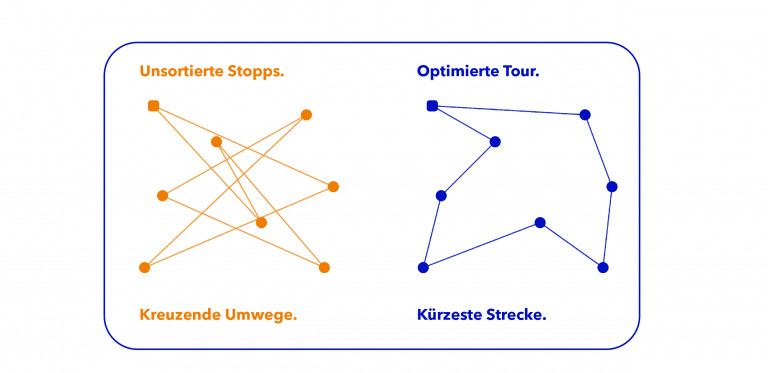
An example illustrates the scale of this: even with just 20 stops, there are mathematically over 2.4 quadrillion possible sequences. With 50 stops, the number of theoretical combinations exceeds the number of atoms in the known universe. No dispatcher can make sense of this complexity in their head. Software, on the other hand, can calculate a practical, near-optimal solution in a matter of seconds.
How does AI-powered route planning work?
Modern route planning software using AI generally takes the following factors into account:
- Historical data: Analysis of past journey times, journey durations and typical delays at specific locations or at specific times of day.
- Time slots and customer requirements: Taking into account fixed delivery times or individual customer requests.
- Vehicle and driver profiles: capacities, load securing, qualifications and statutory driving and rest periods.
- Sustainability targets: Optimising CO₂ emissions is also playing an increasingly important role, for example through the targeted integration of electric vehicles, including planning for range and charging times.
The result is a dynamic route plan that not only calculates the shortest route, but also identifies the most economically and operationally viable solution, taking all relevant factors into account.
What are the specific benefits of AI-powered route planning?
Time savings in planning. Planning processes that take hours to complete manually can be reduced to a matter of minutes with the help of AI. This frees up dispatchers’ time to deal with complex exceptional cases and engage directly with customers, rather than having to work their way through spreadsheets.
Cost savings. Companies that rely on AI-powered route optimisation often report a noticeable reduction in fuel costs, as empty runs and detours are minimised. Vehicle wear and tear is also reduced when routes are consistently optimised rather than improvised.
Improved on-time delivery. Through real-time rescheduling in the event of disruptions – such as road closures or last-minute changes to orders – the system immediately calculates new, adjusted route plans for the entire fleet, rather than allowing a single delay to throw the whole day’s schedule into disarray.
Greater predictability despite increasing complexity. The more stops, vehicles and special rules a route has to take into account, the greater the advantage of algorithmic planning over manual work. Growing businesses in particular benefit because the software can scale in line with increasing order volumes without the dispatch team needing proportionally more staff.
Sustainability as a side effect. Fewer kilometres travelled and better vehicle utilisation automatically reduce CO₂ emissions – a factor that is now also relevant for many companies from a reporting and customer perspective.
How much potential is there in your route planning?
Berechnen Sie mit unserem Einsparrechner in wenigen Minuten, welche Zeit- und Kosteneinsparungen möglich sind.
Which sectors is AI route planning suitable for?
A common misconception is that AI-powered route optimisation is only cost-effective for large fleets with hundreds of vehicles. In practice, the costs are often recouped even for much smaller teams, once the time saved on planning and the reduced travel costs are factored in. The technology is relevant for:
- Waste management companies
- Food and Fresh Produce Logistics
- Bakeries
- Wholesale
- Laundry logistics
- Parcel and courier services
- Passenger transport
- Service and after-sales companies
The more complex the planning, the greater the benefits tend to be.
Will AI replace the dispatcher?
No. A common misconception is that artificial intelligence will completely replace humans. In practice, this is not the case.
Experienced dispatchers possess valuable knowledge that cannot be fully automated, such as customer requirements, regional characteristics or short-term operational needs.
The strength of modern route-planning software therefore lies in combining AI with human experience.
Conclusion.
KI-Tourenplanung ist kein reines Buzzword, sondern eine praxisrelevante Weiterentwicklung der klassischen Routenoptimierung. Unternehmen, die manuelle oder Excel-basierte Planung durch intelligente Algorithmen ersetzen, profitieren von schnelleren Planungsprozessen, geringeren Kosten und einer höheren Termintreue, bei gleichzeitig voller Kontrolle über die finale Tour.
Möchten Sie wissen, wie KI Ihre Tourenplanung optimieren kann?
Unsere Tourenplanungssoftware unterstützt Unternehmen dabei, Touren schneller zu planen, Leerfahrten zu reduzieren und Disponenten zu entlasten.